

Why I Bake with Freshly Milled Flour (and Why You Might Want to Try It Too)
Jump to RecipeThe first time I baked with freshly milled flour, I was a mixture of high expectations (have you heard of Bread Beckers?) and overwhelm.


That first loaf was greeted with much anticipation by the whole family— we definitely did not wait for it to cool before slicing into it. It had richer flavor, better texture, and a depth that store-bought flour had ever given me. What started as curiosity quickly became a conviction: this was how flour was meant to be used.
Before my freshly milled flour journey, I was doing all sourdough. I have followed Farmhouse on Boone on YouTube for years and follow her easy, daily rhythms. In fact, it was through her podcast that I first learned about Bread Beckers and that got me hooked on Sue’s podcast for a good while. After binging a few years of content… I knew we had to get a mill.
I borrowed a mill from a friend for a month or so while I waited for my MockMill 200 to be in stock. I love this mill so much!
Freshly milled flour has been a game-changer in my kitchen, and for my family, and today I want to share why—especially as I introduce my first recipe using it here on the blog.
What Is Freshly Milled Flour?
Freshly milled flour is made by grinding whole wheat berries at home, usually just minutes or hours before baking. Unlike commercial flour, which is milled months (or even years) before it reaches store shelves, fresh flour still contains the full grain—the bran, germ, and endosperm—exactly as God designed it.
Once wheat is milled, it immediately begins to lose nutrients through exposure to air and light. That’s why most store-bought “whole wheat” flour has already lost much of its original nutritional value by the time we use it.
The Nutritional Difference Is Significant
Educators like Sue Becker have long emphasized that freshly milled flour is nutritionally superior to commercial flour—and the science backs it up.
Fresh flour contains:
- Naturally occurring vitamins like B vitamins and vitamin E
- Essential minerals such as magnesium, zinc, and iron
- Healthy fats found in the wheat germ
- Enzymes that aid digestion
Commercial flour, on the other hand, is often stripped of the wheat germ and bran to extend shelf life. Some nutrients are later “enriched,” but many of the original compounds—especially enzymes—can’t be restored.
In simple terms: fresh flour feeds your body in a way refined flour just can’t.
Better Digestion, Better Satiety
One of the most common things people notice after switching to fresh flour is how satisfied they feel after eating it. Many also report easier digestion.
This may be because freshly milled flour:
- Contains living enzymes
- Has intact fiber from the whole grain
- Hasn’t been oxidized by long storage
While everyone’s body is different, many families find that baked goods made with fresh flour feel more nourishing and less heavy.

The Flavor Alone Is Worth It
Even if nutrition weren’t part of the equation, I’d still choose freshly milled flour for the taste.
Fresh flour has a warm, slightly sweet, almost nutty flavor that brings depth to bread, muffins, pancakes, and more. It tastes alive. Recipes made with it feel more homemade in the truest sense of the word.
As Lisa from Farmhouse on Boone often shares, baking with real ingredients slows us down and reconnects us to traditional skills that sustained families for generations—and I’ve found that to be deeply true.
Is It Hard to Use?
This is the part that stops many people—but it’s simpler than it sounds.
Yes, freshly milled flour behaves a little differently:
- It absorbs more liquid
- Dough may need a short rest (autolyse)
- You may need slightly more hydration
But once you learn a few small adjustments, it becomes second nature. Though there is a bit of a learning curve, it’s definitely worth it.
Is milling from home worth the effort?
Choosing to mill your own flour might seem daunting, even a little crazy at first. But it might just be the stepping off point for intentional choices for your family.
What you feed your family may seem small, even insignificant, but these quiet, faithful acts often shape us just as much as they feed our families. In fact, I believe they can have eternal value, which you can read about in this post.
Why This Recipe Uses Freshly Milled Flour
The recipe below was chosen intentionally. It’s forgiving, nourishing, and a wonderful introduction to baking with fresh flour—whether this is your first time milling grain or your hundredth loaf.
My hope is that this recipe doesn’t just feed your family today, but encourages you to explore more traditional, life-giving ways of cooking and caring for your home.
Because sometimes the simplest changes—like how we mill our flour—can make the biggest difference.
This recipe for everyday sandwich bread is versatile and easy. If you use sourdough, you can substitute the yeast for 1 cup of active starter and adjust the rising time to fit your kitchen’s sourdough rhythms.
For my family, I use mainly yeast when making sandwich breads, rolls, etc. but I still use sourdough in plenty of other things.
When I first started out, I bought Sue Becker’s cookbook and started with her recipes – I wanted to have immediate success and not be frustrated with trying to figure out conversions.
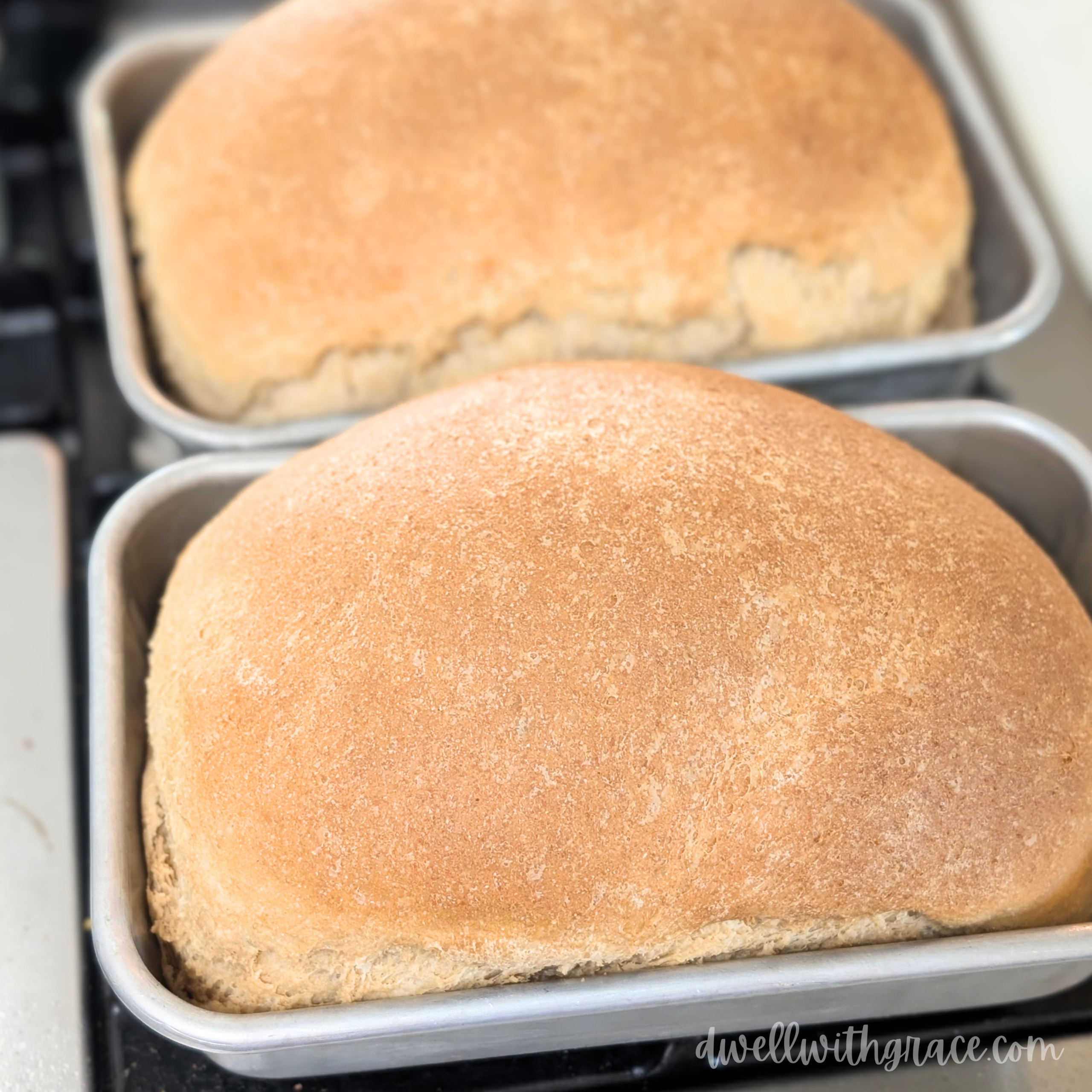
This recipe is scaled to fit my large family – it makes 2 1-lb loaves, 1 large sandwich loaf in my Pullman Pan, or 18 Rolls. What I do most often is make a 1-lb sandwich loaf and 9 dinner rolls.

My family loves to grab a quick roll as a snack and not have to slice any bread!


Fresh Milled Everyday Sandwich Bread
Ingredients
Equipment
Method
- Measure and mill your wheat berries. I have found that 5 cups total berries pre-milled is the perfect amount for my kitchen.3 cups hard white wheat berries, 2 cups hard red wheat berries
- While the grain is milling, add warm water, oil/melted butter, honey, salt, and eggs, if using, to the bowl of your stand mixer.2.25 cups warm water, .5 cup olive oil, coconut oil, or butter, .5 cup honey, 2 eggs, 1 tbsp salt
- Add 5-6 cups of flour to the mixing bowl fitted with the dough hook attachment and mix until a soft dough is formed
- optional rest period: if you have the time, allow the dough to rest at this stage for 30 min or as long as needed, up to 24 hours! This period allows the grain to absorb all the liquid
- Add yeast and knead for 5-15 min, until the dough passes the windowpane test. At this stage, if your dough is still very sticky, add more flour, .25 cups at a time and continue kneading.4 tsp instant or rapid rise yeast
- Once the dough is at the windowpane stage, allow the dough to bulk rise for 1 hour. It should double in size during this time. If your kitchen is on the cooler side, it may take longer. If it is warm, it might prove more quickly.
- After bulk rise, shape the dough as desired. This could be 2 1-lb loaves, a large 2-lb loaf, or even rolls! This recipe will make 18 rolls, avg 80g each.
- Preheat your oven to 350℉
- Allow the dough to have a second rise of 30-45 min, until it has roughly doubled in size.
- If desired, brush the top of your dough with an egg wash, or milk.
- Bake! Small loaves and rolls will bake for 35 min, a large loaf will take an average of 45 min. Bake until the dough registers at least 190℉
- Allow to cool completely, if you can wait that long!!
Notes
- I am using the MockMill 200 and I absolutely love it. You can use any good quality grain mill
- I have used many different types of oil in this and all have turned out beautifully
- If you would like to convert this recipe to sourdough, omit the yeast and add up to 1 cup of active starter.
- bulk rise will be anywhere from 8-24 hours, depending on the temperature of your kitchen
- 2nd rise will be 2-6 hours
- You can also do a cold ferment in the fridge after the bulk rise and before shaping.



Comments are closed